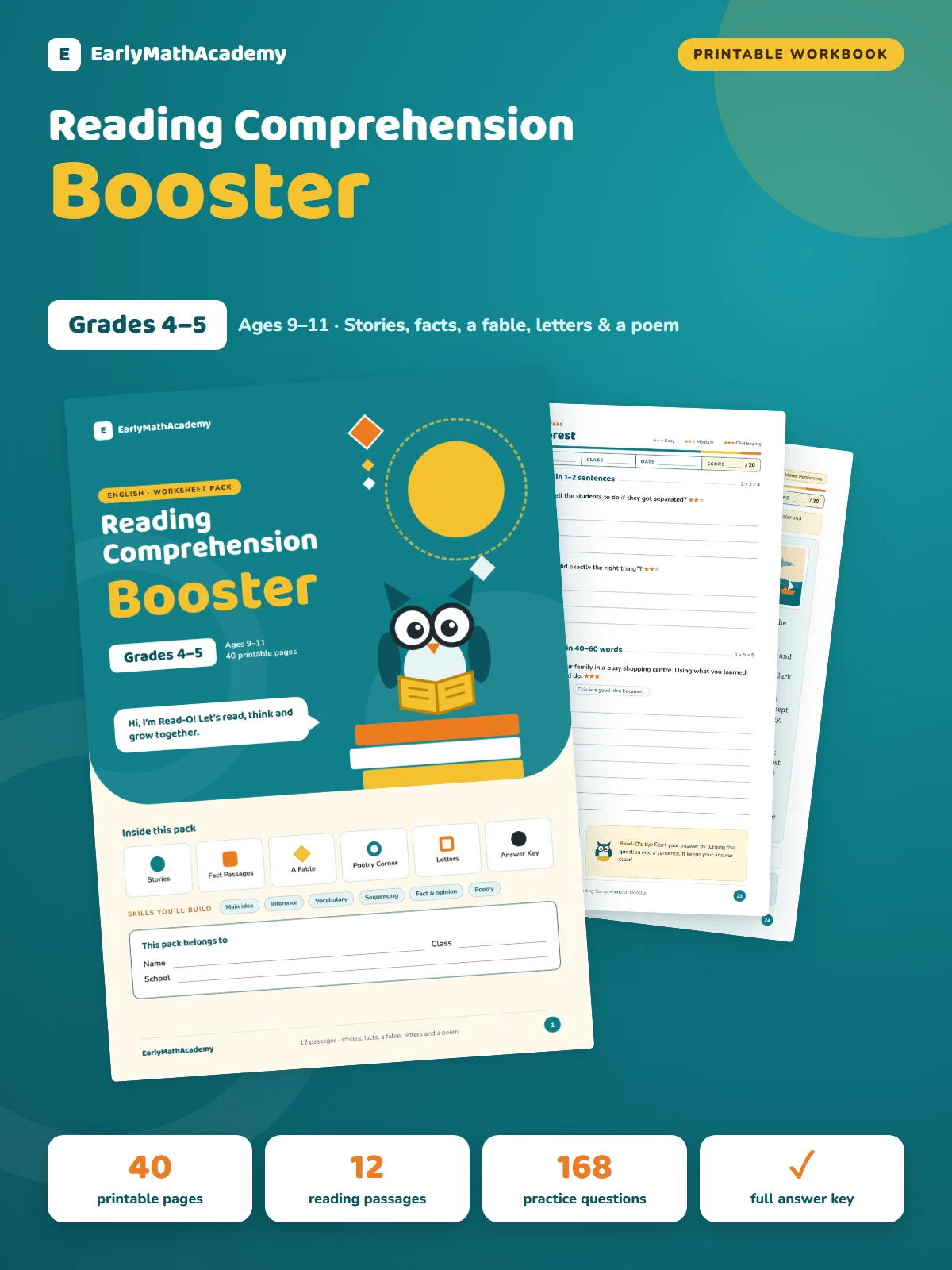
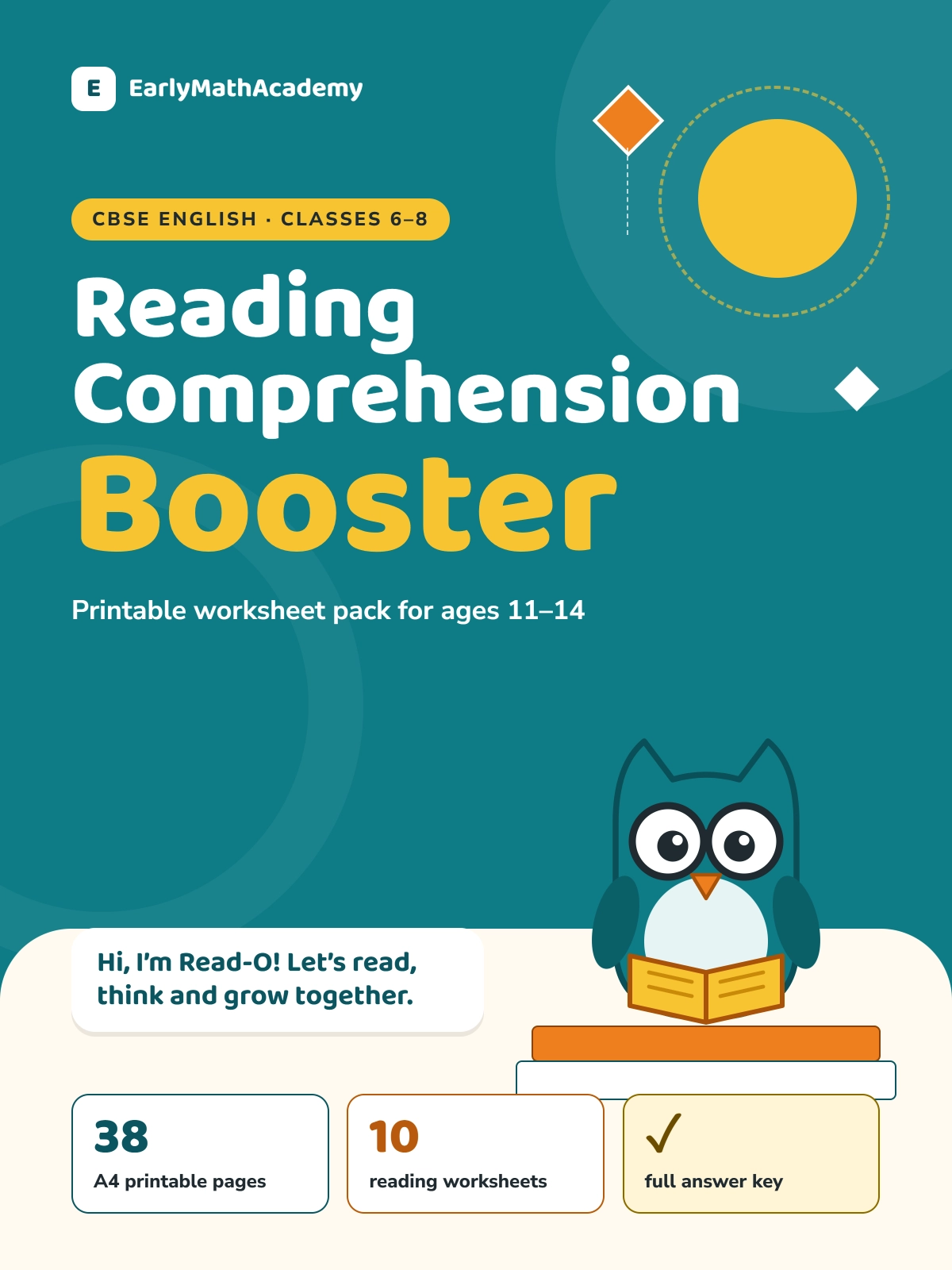
Reading Comprehension Test Practice for Grades 4 to 8
A reading comprehension test looks simple: read a passage, answer some questions. Yet many students lose marks they did not need to lose, because they read too fast, answer a different question from the one asked, or give an answer with no reason. This guide explains how a reading comprehension test works, a method that helps in 4th, 5th, 6th, 7th and 8th grade, and gives a short sample passage so you can try the method straight away.
How a reading comprehension test works
Most reading comprehension tests follow one pattern: a passage, then questions about it. The passage may be a story, a factual text, a poem, a letter or a notice. In many tests the passage is unseen, which means the student has not read it before, so the test checks the skill and not the memory.
The questions usually come in a few forms:
- Multiple choice: pick the best answer from a list.
- True or false: decide, and sometimes give the line from the passage that proves it.
- Short answer: one or two sentences.
- Long answer or summary: a few sentences in the student’s own words.
- Vocabulary: say what a word means in the passage.
A method for any reading comprehension test
- Skim first. Look at the title and the first line. Ask what the passage is probably about.
- Read the questions. Knowing what you are asked helps you notice the right lines when you read.
- Read the passage carefully. Underline names, places, numbers and the words that look important.
- Answer the easy questions first. This builds confidence and saves time for the harder ones.
- Go back to the passage for every answer. Put a mark by the line that proves it. Do not answer from memory.
- Write in full sentences where the question asks for it, and use words from the passage as evidence.
- Check. Keep a few minutes to make sure every question has an answer and the spelling is right.
Try it: a short sample passage
Read the passage once, then try the questions before you look at the answers. The passage was written for this guide.
The Lamp on the Hill
Every evening, Mr Rao climbed the hill behind the village to light the old lamp at the top. Nobody had asked him to do it. The lamp had once guided fishing boats home, but now the boats had engines and radios, and most people thought the lamp was no longer needed.
One stormy night the radios stopped working. The boats were far out at sea and the sky was black. Mr Rao climbed the hill in the rain and lit the lamp. Hours later, the first boat turned toward the shore, and then another, until all of them were safe on the beach.
The next morning, the fishermen walked up the hill with a gift: a new can of oil for the lamp.
Questions
- What did Mr Rao do every evening? (short answer)
- True or false: The fishermen asked Mr Rao to light the lamp. Give a reason. (true or false)
- Why did people think the lamp was no longer needed? (short answer)
- What is the meaning of “guided” in the first paragraph? (vocabulary)
- What does the gift of oil tell you about how the fishermen felt? (inference)
Answers
- He climbed the hill behind the village to light the old lamp at the top.
- False. The passage says “Nobody had asked him to do it.”
- Because the boats now had engines and radios.
- “Guided” means showed the way to.
- They were grateful. The gift shows they understood that the lamp had saved them and wanted him to keep lighting it. This is an inference, because the passage does not say it directly.
Notice how question 5 asked for something the passage hints at but does not state. That kind of question is common from 5th grade onward, and a good answer gives a feeling and a reason.
What changes from grade to grade
The method stays the same, but the passages and questions grow. This is a general guide, so check your own school’s syllabus.
- 4th grade reading comprehension focuses on finding the main idea and facts, and working out new words from the sentence.
- 5th grade reading comprehension adds more inference, cause and effect, and short summaries.
- 6th grade reading comprehension often introduces unseen passages and a wider mix of text types.
- 7th grade reading comprehension leans on inference and backing an answer with evidence.
- 8th grade reading comprehension tends to use longer passages and asks students to separate fact from opinion and to summarise.
Reading comprehension test practice in PDF
Practice works best when the passages vary and the answers can be checked. The Reading comprehension booster for Classes 4-5 has 12 passages with 14 questions each and a full answer key with a marking scheme out of 20. The Reading comprehension workbook for Classes 6-8 has 10 reading worksheets, an unseen passage test, a 20-mark revision paper and an answer key for every question.
Browse by grade:
- 4th grade reading comprehension worksheets
- 5th grade reading comprehension worksheets
- 6th grade reading comprehension worksheets
- 7th grade reading comprehension worksheets
- 8th grade reading comprehension worksheets
Or see all reading comprehension worksheets. For general habits that build the skill, read how to improve reading comprehension in Class 6-8.