How to Improve Reading Comprehension in Class 6-8
Reading a passage and understanding it are not the same thing. A child can read every word aloud and still not be able to say what the passage was about. This guide explains what reading comprehension is, the strategies that help, how to improve reading comprehension for kids, and how to prepare for a reading comprehension test in Class 6, 7 and 8 (often called 6th, 7th and 8th grade).
What is reading comprehension?
Reading comprehension is the ability to read a text, understand it, and use that understanding. In practice that means a reader can:
- say what the passage is mainly about;
- find the details that matter and ignore the ones that do not;
- work out what the writer means but does not say directly;
- explain the meaning of a new word from the sentence around it; and
- give an answer in their own words, with a reason.
Every school subject is learned by reading, so this skill helps well beyond the English lesson.
Reading comprehension strategies that work
A strategy is a habit a reader can use on any passage. These are simple enough to teach a child in one sitting:
- Preview. Look at the title, any picture and the first line before reading. Ask what the passage might be about.
- Read actively. Read with a pencil. Underline names, places and dates, and put a question mark beside anything unclear.
- Find the main idea. After each paragraph, say in one short sentence what it was about.
- Use context for new words. Read the sentence before and after the word. Ask what meaning would make sense there.
- Read between the lines. Ask what the writer hints at but does not state, and which words give the clue.
- Check the question. Many wrong answers come from answering a different question. Read each question twice and notice words such as why, how and which one.
- Summarise. Finish by telling the passage back in two or three sentences.
How to improve reading comprehension for kids
Strategies matter, but so do habits at home. To improve reading comprehension, try these:
- Read a little every day. Fifteen to twenty minutes of reading that the child enjoys is a good start. Stories, poems, news for children and factual articles all count.
- Talk about what was read. Ask “What happened?”, “Why do you think she did that?” and “What would you have done?” The talk matters more than the quiz.
- Ask for a retelling. A child who can retell a passage in their own words has understood it.
- Grow vocabulary. Learning roots, prefixes and the meanings of words in context makes harder passages easier to read.
- Practise with passages and questions. Short, regular practice on different kinds of text builds the skill that tests ask for.
- Praise the method, not only the score. “You went back to the paragraph to check” is worth saying.
What changes in 6th, 7th and 8th grade reading comprehension
The idea stays the same from year to year, but the passages and questions grow harder.
- 6th grade reading comprehension (Class 6) often focuses on getting the main idea, finding details and understanding the meaning of new words.
- 7th grade reading comprehension (Class 7) usually asks for more inference: what a character feels, why something happened, and how you know.
- 8th grade reading comprehension (Class 8) tends to add longer passages, a mix of text types, and questions that ask a reader to separate fact from opinion or to summarise.
Check your child’s own textbook and school for exactly what is taught in each class.
How to prepare for a reading comprehension test
A reading comprehension test usually gives an unseen passage, which the student has not read before, followed by questions. A routine that helps:
- Read the passage once without stopping, for the general idea.
- Read the questions before the second reading, so you know what to look for.
- Read again and mark the lines that answer each question.
- Write answers in full sentences where the question asks for them, and use words from the passage as proof.
- Keep a few minutes at the end to check spelling, and to check that every question has an answer.
Timed practice on unseen passages, followed by checking against an answer key, is the quickest way to get comfortable.
Reading comprehension worksheets and PDF practice
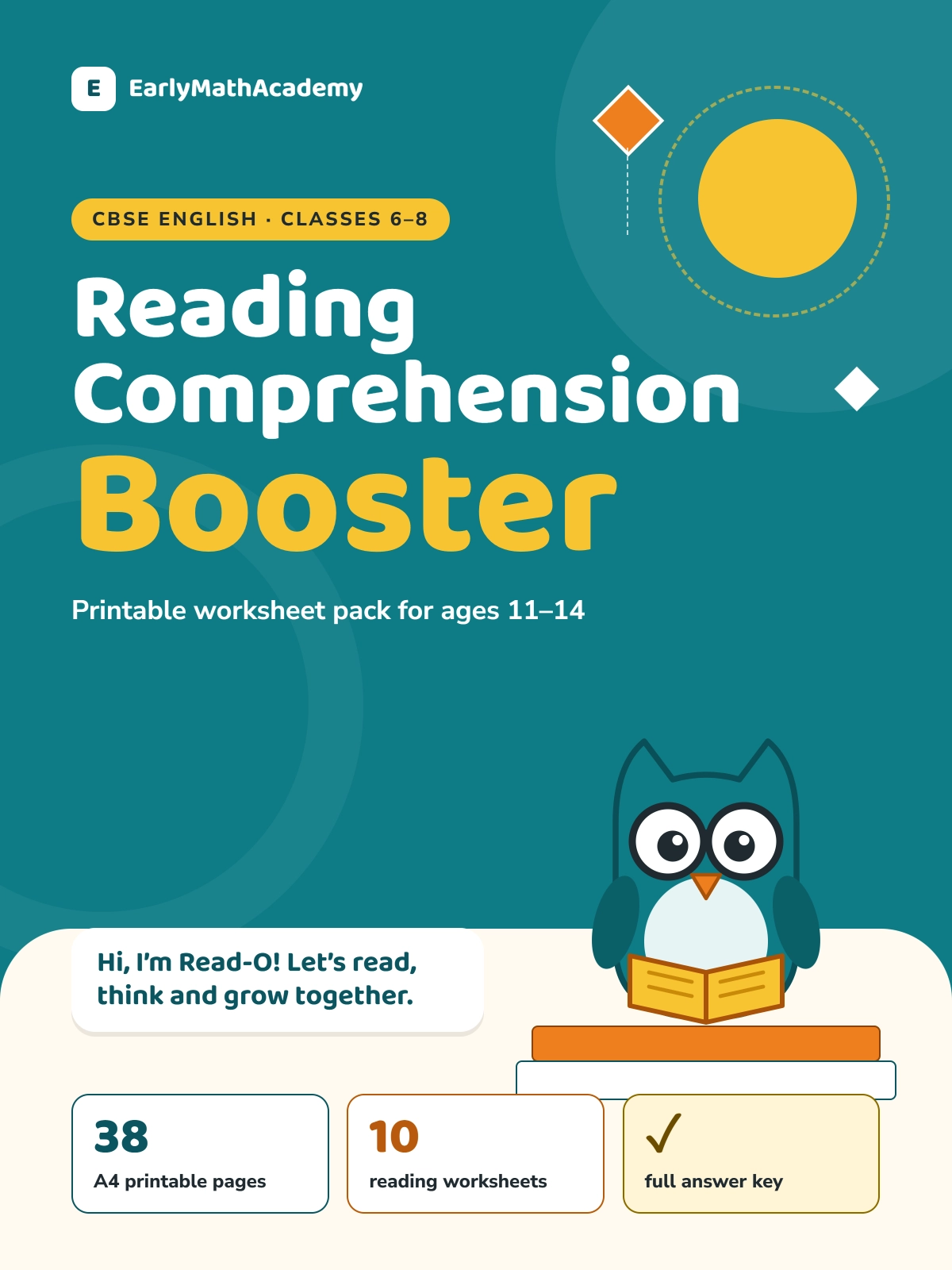
If you are looking for 6th grade reading comprehension PDF practice, or the same for 7th and 8th grade, regular practice works best when the passages vary and the questions come in different forms. The Reading comprehension workbook for Classes 6-8 is a printable PDF with 10 reading worksheets. It has stories, factual passages, a biography, poems, a school notice and advertisement, and a diary entry. Its questions include MCQs, true or false, match the following, fact or opinion, short answers and long answers. It also has an unseen passage test, a 20-mark revision paper and an answer key for every question.
You can browse the worksheets for your child’s class:
For a guide covering every age, see reading comprehension strategies for kids. For test practice with a sample passage, see reading comprehension test practice for grades 4 to 8. All grades are on the reading comprehension worksheets page, including 6th grade, 7th grade and 8th grade reading comprehension.