Reading Comprehension Strategies for Kids
Many children can read every word on the page and still struggle to say what it meant. That gap is common, and it is not a sign that a child is “bad at English”. Understanding a passage is a separate skill from reading it aloud, and it can be taught. This guide covers the reading comprehension strategies that work, how to improve reading comprehension for kids at home, and the printable practice available on this site.
What is reading comprehension?
Reading comprehension is the ability to read a text, understand it and use that understanding. A child with good comprehension can:
- say what a passage is mainly about;
- find the facts and details that answer a question;
- work out what the writer hints at but does not say;
- explain a new word from the sentence around it; and
- answer in their own words, with a reason.
Every school subject is learned through reading, so this skill helps in maths word problems, science and social studies as much as in English.
8 reading comprehension strategies kids can use
A strategy is a habit a reader can apply to any passage. Teach them one at a time, and let your child practise each one before adding the next.
- Preview before reading. Look at the title, any picture and the first line. Ask: “What do I think this is about?” A reader who has a guess is already thinking.
- Read with a pencil. Underline names, places, dates and key words. Put a question mark beside anything that is unclear. Marking the page keeps a child awake while reading.
- Stop and say the main point. After each paragraph, tell the main idea in one short sentence. If your child cannot, that paragraph needs a second reading.
- Use the sentence around a new word. Read the sentence before and after the word, then ask what meaning would make sense there. This is called using context clues, and it builds vocabulary without a dictionary.
- Ask questions as you read. “Why did she do that?” and “What happens next?” turn reading into a conversation with the text.
- Read between the lines. Inference means working out what the writer does not say directly. Ask: “How do you think he feels? Which words tell you?”
- Go back to the text. For every answer, point to the line in the passage that proves it. This stops guessing and trains careful reading.
- Summarise at the end. Tell the whole passage back in two or three sentences. A child who can summarise has understood.
How to improve reading comprehension for kids at home
Strategies work best when they sit on top of good habits. Here is what parents can do.
- Read together every day. Even older children enjoy being read to. Take turns with paragraphs, and choose books and articles your child actually likes.
- Talk about what you read. Ask “What happened?”, “Why do you think that?” and “What would you have done?” Open questions teach more than a quiz.
- Ask for a retelling. A child who can retell a story in order, with the main events, has understood it.
- Build vocabulary. The more words a child knows, the less they get stuck. Learn new words in sentences, not as a list, and look at roots, prefixes and suffixes.
- Mix the kinds of text. Stories, facts, letters, notices and poems are each read a little differently. Variety prepares a child for any passage.
- Practise a little, often. One passage with questions, a few times a week, beats one long session on a Sunday.
- Praise the method, not only the score. “You went back and checked the paragraph” tells your child what to repeat.
- Keep it kind. If a passage is too hard, pick an easier one. Confidence matters as much as skill.
Which strategies to focus on at each age
Children grow into these skills gradually, and schools differ, so check your child’s textbook and teacher for what is taught in each class. As a rough guide:
- Younger readers (Classes 1-3) need picture clues, retelling and simple “who, what, where” questions.
- 4th and 5th grade (Classes 4-5) are the years for finding the main idea, picking out details, using context for new words and starting inference. See reading comprehension for 4th and 5th grade.
- 6th to 8th grade (Classes 6-8) add unseen passages, longer texts, fact versus opinion, and summaries. See how to improve reading comprehension in Class 6-8.
Why worksheets help
Strategies only become habits with practice, and worksheets give that practice a routine. A good reading comprehension worksheet has a passage worth reading, questions that run from easy to hard, and an answer key so a parent can check quickly. Because the passages are different each time, a child learns to apply a strategy to a new text rather than memorise one.
Reading comprehension worksheets on EarlyMathAcademy
Two printable PDF workbooks on this site are made for exactly this practice.
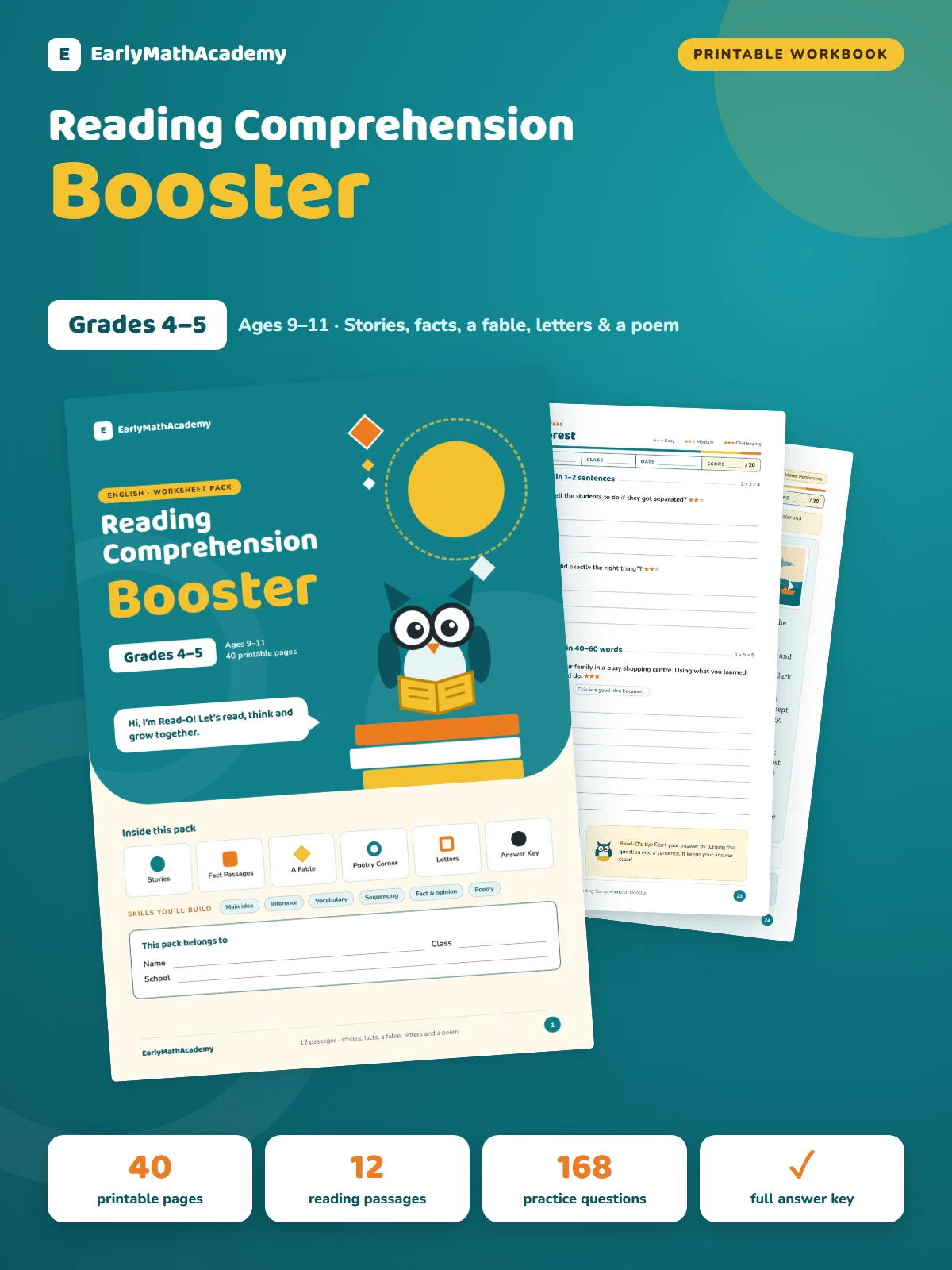
Reading comprehension booster for Classes 4-5 (4th and 5th grade, ages 9 to 11) is a 40-page A4 PDF with:
- 12 reading passages, including mysteries, animal and space facts, a fable, an adventure, letters from camp and a poem;
- 14 questions on every passage, 168 in all, from easy recall to deeper thinking, with difficulty stars;
- skill tasks such as fact or opinion, cause and effect, problem and solution, and ordering the events;
- worksheets scored out of 20, a reading journey tracker; and
- a full answer key with model answers and a marking scheme.
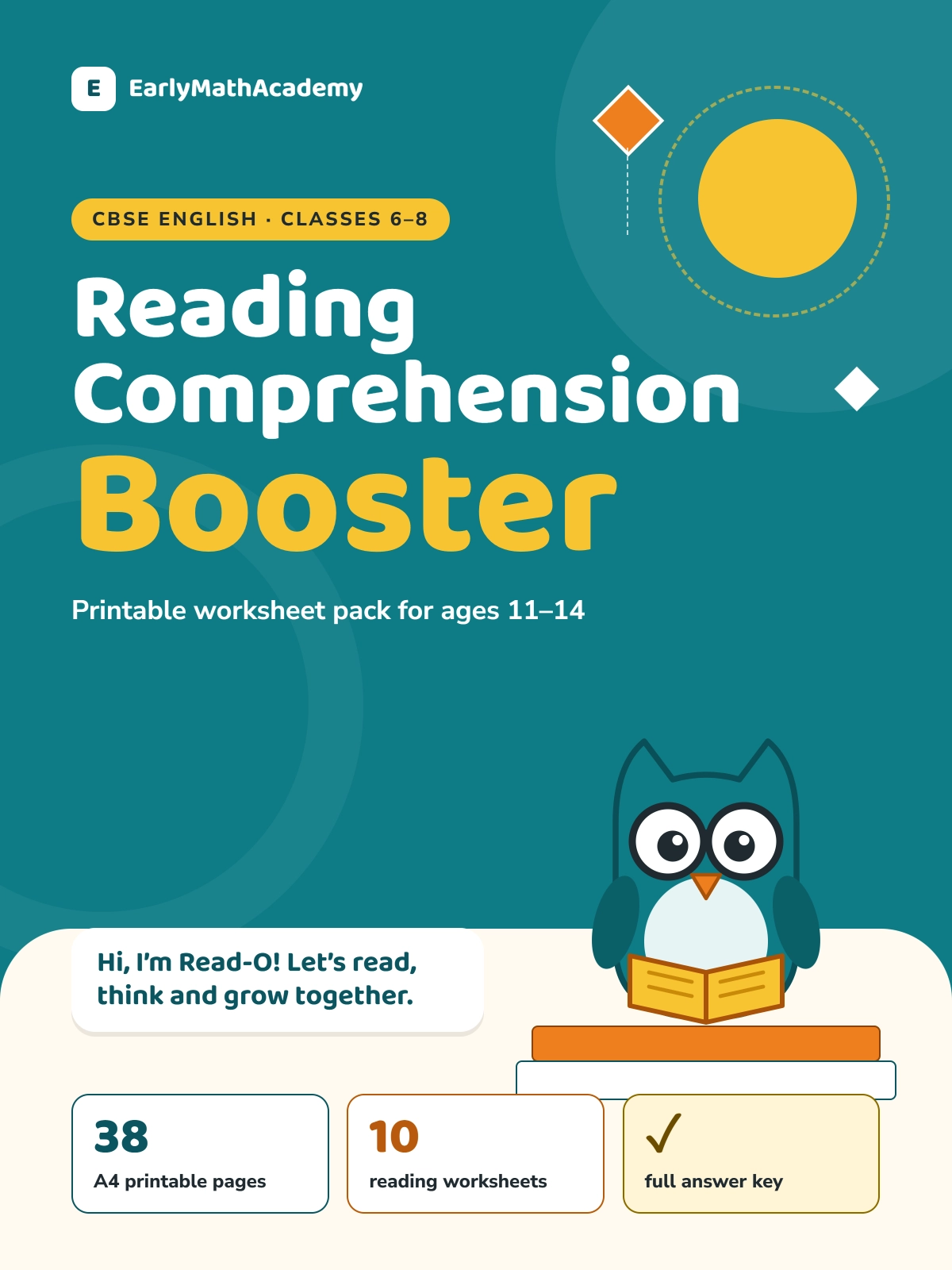
Reading comprehension workbook for Classes 6-8 (6th, 7th and 8th grade) is a 38-page printable PDF with:
- 10 reading worksheets, with stories, factual passages, a biography, poems, a school notice and advertisement, and a diary entry;
- MCQs, true or false, match the following, fact or opinion, short and long answers, with difficulty stars;
- an unseen passage test and a 20-mark revision paper;
- a score tracker and a certificate of completion; and
- an answer key for every question.
Both come as a PDF you download after payment from Your purchases, and print it for your own family or your own students, as the licence allows. See the delivery policy and copyright and licence pages for the details.
You can also browse by grade:
- 4th grade reading comprehension worksheets
- 5th grade reading comprehension worksheets
- 6th grade reading comprehension worksheets
- 7th grade reading comprehension worksheets
- 8th grade reading comprehension worksheets
A simple weekly routine
Here is one way to put the strategies to work without it feeling like a chore:
- Two or three days a week: one worksheet passage. Preview, read with a pencil, then answer the easier questions first.
- Check together: use the answer key, and for each wrong answer ask your child to find the line in the passage that shows the right one.
- Every day: 15 to 20 minutes of reading for pleasure, followed by one “tell me about it” question.
- Once a week: a new word or two, used in a sentence of your child’s own.
Preparing for a school test? Read reading comprehension test practice for grades 4 to 8, which includes a short sample passage with questions and answers. All our titles are listed on the reading comprehension worksheets page.